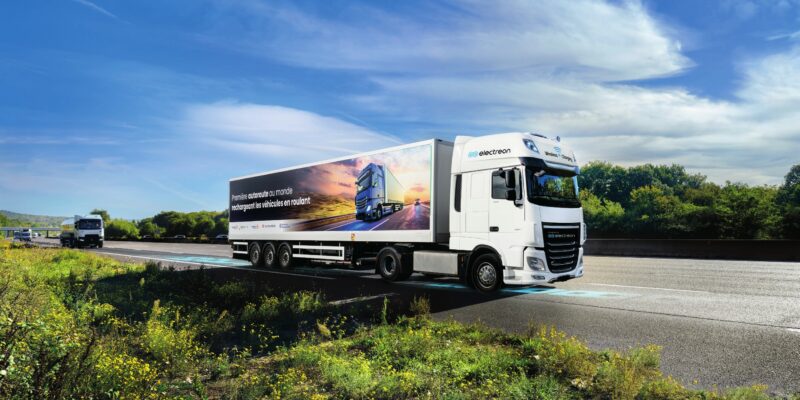
By testing dynamic induction charging on a pilot section of the A10 motorway, a world first, VINCI Autoroutes demonstrates the potential of this technology.
Electrifying road transport is crucial to tackling climate change and reducing CO₂ emissions. However, high-capacity batteries for heavy-duty vehicles (HDVs) present several challenges: excessive weight that reduces payload, to match long downtimes for charging purposes, high cost and a significant environmental footprint.
As a complement to static charging points, Electric Road Systems (ERS) offer a strategic alternative: charging vehicles while they are on the move in order to reduce the size of onboard batteries. The charge as you drive project confirms the potential of this solution to decarbonise heavy-duty road mobility.
Road transport electrification at a forced pace
The European Union has set a strict decarbonisation pathway for HDVs, with targets to reduce CO₂ emissions from new vehicles on the market by 45% from 2030, 65% in 2035 and 90% in 2040, compared with 2019 levels. To support this transition, the AFIR Regulation requires the deployment of high-power charging stations every 60 to 100 km on Europe’s main routes. In France, the benchmark study carried out by TotalEnergies, Enedis and VINCI Autoroutes in 2024 highlights the scale of the challenge: it estimates that around 12,000 charging points will be needed on the national road network for long-distance freight transport by 2035.
On the vehicle side, despite genuine technological progress, electric HDV uptake in France remains far too limited. Representing only around 2% of registrations in 2025, sales volumes are still insufficient to put the sector on track for its 2030 targets. Despite massive investment, manufacturers are caught between strict regulatory targets and a demand that is struggling to develop beyond a few pioneering markets.
Beyond static charging points: electric roads as a lever for more efficient and sovereign heavy mobility
For transport operators, rolling out an electric road network would radically transform the economic equation of fleet electrification. By enabling vehicles to recharge while driving, this solution would drastically reduce the size of onboard batteries, thereby lightening the vehicle, restoring payload capacity, improving energy efficiency and lowering purchase costs. ERS would act as a universal range extender, eliminating lengthy stops and optimising fleet operating time.
For manufacturers, interoperability between dynamic charging and static charging points would be strategic: it would avoid any technological lock-in to risky and incompatible industrial choices. ERS receivers would simply be “an additional plug” on an electric vehicle equipped with a smaller battery, while still allowing it to recharge at a charging point, particularly at the depot.
For electricity network operators, this approach would limit pressure on distribution grids by smoothing power demand beyond the mandatory rest breaks of HDV drivers, across the highway network as a whole rather than concentrating it at service areas.
The adoption of ERS would also address major macroeconomic challenges by enabling investment in national road infrastructure instead of large-scale battery imports (€27 billion worth of batteries were imported by Europe in 2023). Reducing battery size would lessen dependence on strategic materials and foreign-made cells, thereby strengthening European industrial sovereignty, creating non-relocatable jobs and supporting a cutting-edge local technology sector.
First pilot projects confirm the potential of dynamic induction charging
The charge as you drive project led by VINCI Autoroutes with support from the investment plan France 2030, in partnership with Electreon, Hutchinson, VINCI Construction and Université Gustave Eiffel, confirms the viability of dynamic induction charging under real motorway traffic conditions on a pilot section of the A10 motorway in the Île-de-France region.
The results show that it is possible to transfer energy wirelessly, at high power levels, to vehicles travelling at motorway speeds.
The trial also demonstrates the mechanical durability of the system under the stresses of heavy traffic, the absence of health risks linked to electromagnetic emissions, and the compatibility of this ERS infrastructure with standard road maintenance operations. By removing these critical barriers, the charge as you drive project confirms that electric roads are a safe solution, ready to be integrated into the national road network.
Overcoming technical, economic and regulatory challenges
Moving from a pilot project to the deployment of the first commercial sections presents major challenges.
- Technical challenges: the standardisation of induction systems to ensure interoperability between different onboard receiver technologies and ground-based charging infrastructure. The challenge is to define universal communication and energy transfer protocols, thereby avoiding technological fragmentation that would hinder large-scale deployment.
- Economic challenges: fully equipping the concession highway network requires massive investment, estimated at several tens of billions of euros. The business model has yet to be stabilised: energy and service access pricing must be defined in a way that is acceptable to transport operators while ensuring infrastructure profitability for infrastructure managers.
- Governance challenges: the deployment of electric road corridors or networks would create an unprecedented governance challenge, requiring close coordination between the State, grid operators, vehicle manufacturers, equipment suppliers, transport operators and highway concessionaires. Public leadership will be essential to trigger the first wave of major investment and ensure secure planning along key corridors. Without political harmonisation, including at the European level, the risk of technological fragmentation would slow uptake among transport operators.
Recommendations and actions for public authorities
To move beyond pilot projects such as the charge as you drive project and achieve large-scale deployment, concrete action is needed.
- Funding for the first corridors: introduce funding mechanisms to support projects aimed at deploying the first commercial sections.
- Integrated planning: incorporate ERS into national energy planning frameworks, such as France’s Multiannual Energy Programme (PPE), and in regulatory frameworks, such as the AFIR Regulation at the European level, so that all stakeholders can plan the associated investments.
- Strategic coordination: ensure consistency between the deployment of ERS infrastructure and fleet equipment, by actively supporting the integration of ERS receivers into new vehicles as well as retrofit solutions to enable rapid uptake across the existing fleet.
Cover: electric heavy-duty vehicle travelling on the experimental section of the A10 highway. © Caroline Gasch pour VINCI Autoroutes